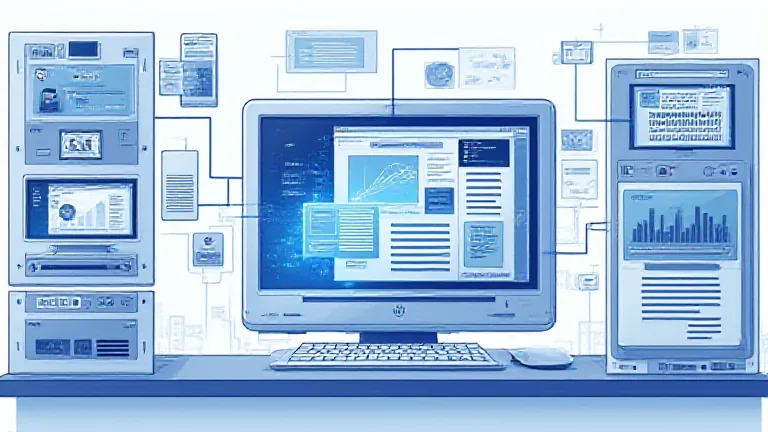
NVIDIA has introduced Nemotron 3 Nano Omni, an open multimodal model that reasons across video, images, audio, and text in a single model. The interesting part is not the input list. It is that a multimodal agent can now be built with fewer separate perception components, fewer handoffs, and less room for orchestration bugs.
What the model is
NVIDIA describes Nemotron 3 Nano Omni as a 30B-A3B mixture-of-experts model. The total parameter budget is large, but only a smaller subset activates on any given inference path.
That distinction matters locally, where operators care about steady-state throughput, memory pressure, and predictable service behavior at least as much as benchmark scores.
Fewer perception services
A local agent that watches a screen, listens for spoken context, reads documents, and reasons over images normally needs a chain of specialized services. That works, but every boundary adds latency, state synchronization, failure handling, and routing complexity.
One model covering several sensory tasks through a single serving path is easier to supervise than a bundle of loosely coupled OCR, audio, vision, and language workers. The perception layer becomes one service producing a coherent context stream for the planner.
What it means for Hermes routing
Hermes routes a request, gathers recent context, and decides whether the task needs screen understanding, document reading, audio context, or plain text reasoning. Today each of those tends to be a separate tool choice.
A unified perception model makes that routing less brittle. Hermes can ask one local service for multimodal context and hand the result to the reasoning layer with fewer conversion steps.
Sensitive inputs stay local
Multimodal inputs are usually the most sensitive inputs in an agent system: screen contents, meeting audio, private documents, camera views, internal dashboards.
Running perception locally keeps those signals inside the operator's own infrastructure. That does not settle the trust question, but it gives auditability, retention control, and failure isolation something to stand on.
Read the benchmarks in context
NVIDIA frames the model around efficient inference and agentic use cases, reports MediaPerf results for multimodal workloads, and positions it for integration with NVIDIA inference tooling.
Those claims come with an obvious caveat: the smoothest deployment path is NVIDIA's own hardware and software. An AMD-heavy environment like OtherU's still needs portability testing, serving benchmarks, and a decision about whether the model belongs in production, in experimentation, or as a reference architecture.
Perception is not agency
Nemotron 3 Nano Omni can help an agent understand richer inputs. A production agent still needs planning, memory, policy checks, tool permissions, rollback paths, and operator-visible traces.
A single multimodal model may simplify the front of the agent loop. It does not remove the need for disciplined design around the rest of it.
Local-first agents are becoming less text-only. If a system is expected to operate a desktop, follow spoken instructions, inspect documents, and reason over visual state, its perception layer has to get more coherent. This release is a reasonable marker of that direction: fewer modality silos, more local context, and a path toward agents that understand the operator's working environment without shipping it to a cloud API.